


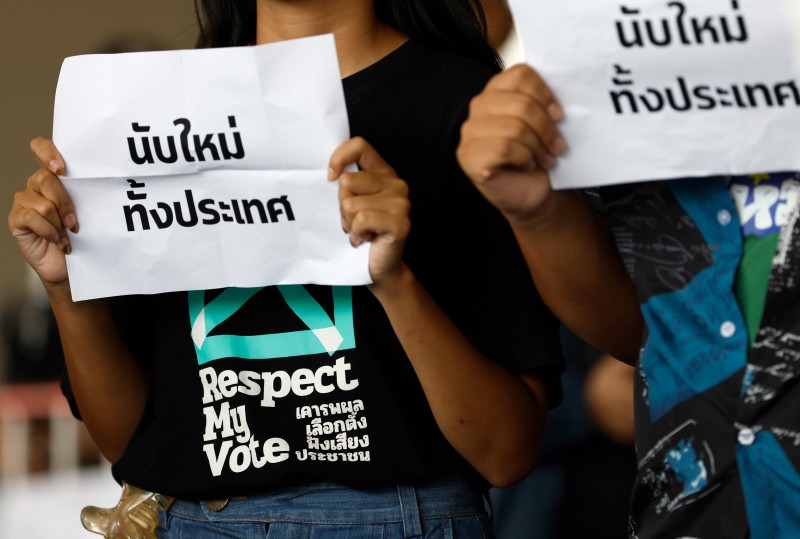
Protest in Bangkok against electoral irregularities in the vote counting (Rungroj Yongrit/EPA IMAGES)
JAKARTA, 12 February 2026—ASEAN Parliamentarians for Human Rights (APHR) has been following the outcome of Thailand’s 8 February 2026 snap election, in which the Bhumjaithai Party, led by Prime Minister Anutin Charnvirakul, received the highest number of seats and is expected to form the next government, while post-election petitions and recount requests in some constituencies are being addressed through established legal processes.
Following a three-day election study mission, APHR’s legislator delegation observed that polling day was conducted in an orderly manner in many locations, reflecting the efforts of election officials and other stakeholders.
At the same time, discussions with a broad range of sectoral stakeholders highlighted several structural and contextual issues that extend beyond voting procedures and are relevant to public confidence in democratic governance. These included challenges related to transparency and access to election-related information, where complex formats, limited data infrastructure and restricted availability of datasets were seen as obstacles to broader public understanding and independent engagement.
The delegation’s observations also zoomed in on the overall framework governing the establishment and functioning of the Election Commission. Stakeholders have highlighted opportunities to enhance transparency, accountability and public confidence in the institution’s operations. APHR therefore encourages a review of the Commission’s terms of reference, including consideration of ways to ensure a more representative and inclusive appointment process, which could be addressed through future constitutional discussions.
Stakeholders also pointed to areas of legal and regulatory uncertainty affecting referendums and political campaigning, including questions around permissible advocacy, advance voting arrangements and resources for voters education. Such ambiguities may contribute to uneven participation and limit informed public debate. Concerns were further raised regarding the broader election environment, including constraints on political expression, allegations of vote buying and the use of legal processes that may influence political competition, which together can affect the openness of the democratic space.
APHR also notes the wider social and digital context in which the election took place, including the spread of disinformation, online harassment and civic vulnerabilities, alongside economic pressures and public concerns about governance and crisis response.
For ordinary people across Thailand, farmers, workers, indigenous and rural communities, youth and civil society actors, the significance of these results will be determined by whether the incoming government advances policies that respond to people’s aspirations for dignity, justice, human rights and a healthy environment.
As a Southeast Asian network of legislators, APHR will continue to engage with affected communities and stakeholders during this period and will continue to monitor post-election developments.
APHR furthermore encourages the new government to demonstrate, through concrete and constructive measures, a commitment to strengthening democratic institutions, protecting human rights and environmental defenders and ensuring meaningful public participation in decision-making.
Upholding these principles will be critical to meeting the legitimate aspirations of the Thai people and to building a just, sustainable and rights-respecting future for Thailand.
www.facebook.com/tcijthai
Tags


